History
AN INTIMATE, LIVELY MUSEUM
Since 1991, the museum, housed in the former schoolhouse, has exhibited a wide range of painted works and a large collection of drawings and illustrated books by the artist. It provides an insight into the life of Yan’ Dargent and presents all the facets of his talent: landscape painter, portraitist, painter of the legendary, painter of the sacred, one of the greatest illustrators of his time.
The Yan’ Dargent Museum was created in 1991 by a local boy, the bibliophile Jean Berthou. The creation of the Yan’ Dargent Museum in the artist’s birthplace has done much to arouse new interest in this painter, who had been forgotten since his death.
A remarkable collection of illustrated books
Yan’ Dargent contributed to around two hundred books and various magazines, including a remarkable edition of Dante’s Divine Comedy (1879), or Mgr Guérin’s La Vie des saints (1884). The museum has an immense collection of books illustrated by Yan’ Dargent: some sixty books in their original editions, and complete collections of magazines illustrated by Yan’ Dargent.
The importance of this collection of books reveals Yan’ Dargent’s talent as an illustrator. It also provides an insight into book production processes in the 19th century, the new techniques for reproducing drawings that reinforced the role of illustration in books (woodcuts, lithography, etc.), the role of illustrators in the 19th century (Gustave Doré, etc.), the emergence of the publishing profession in the 19th century, the preoccupations of the second half of the 19th century (popular science, children’s stories, the Catholic faith, discovery of the world, etc.)…
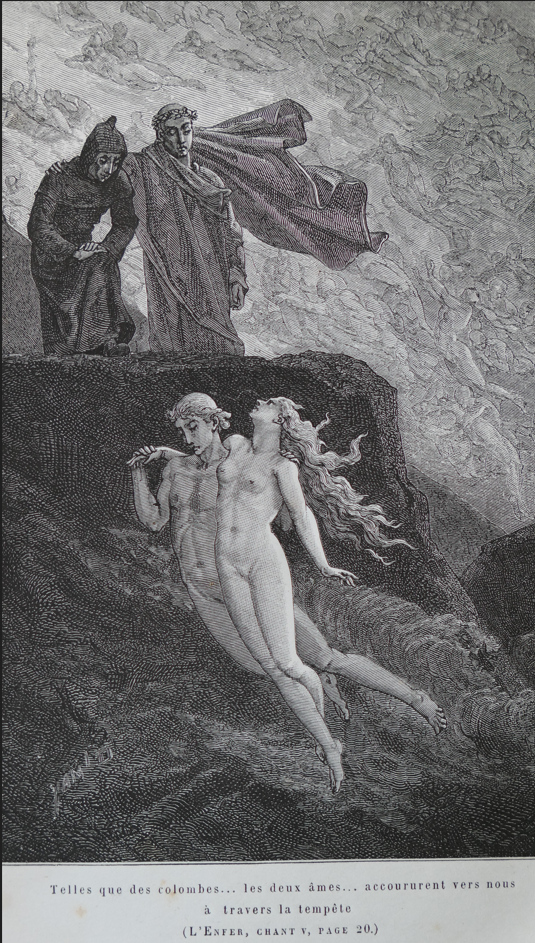
Paolo and Francesca
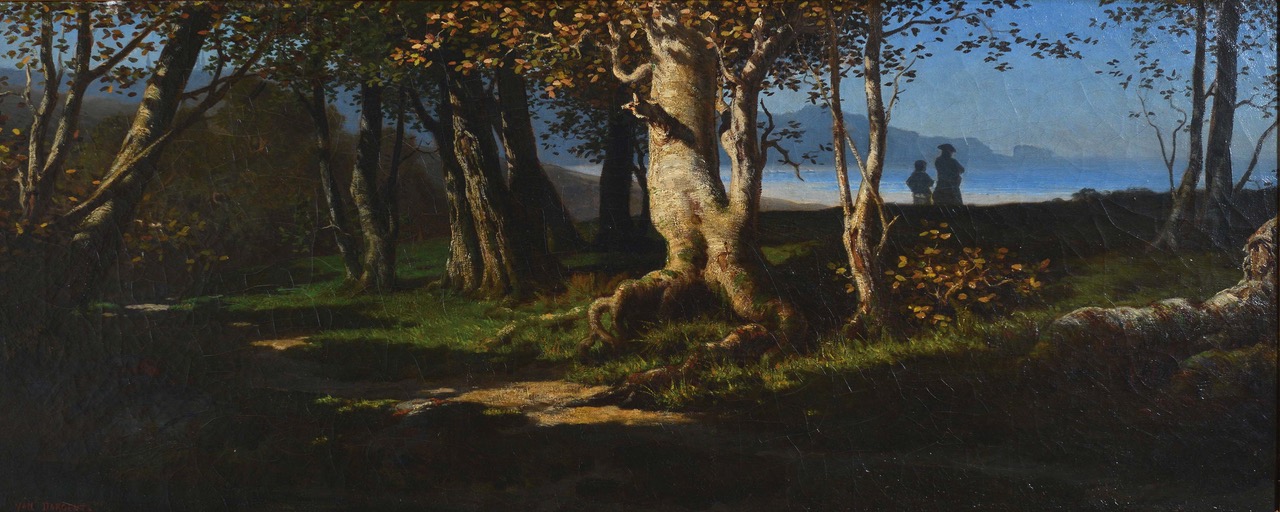
Seaside in Carantec
Breton landscapes and legends
For paintings and drawings, the collection began in the museum’s first year, 1991, with La Queue de l’étang de Brézala place near the village of Saint-Servais that Yan’ Dargent loved and often painted. Yan’ Dargent was a great landscape painter. He never stopped painting the landscapes of his childhood, the moors, sunken lanes and woods he frequented. Several paintings in the museum bear witness to this talent: The return of the herd on a stormy evening, Seaside at Carantec…
Yan’ Dargent made his name above all by depicting the legends he had heard as a child. His painting Les Lavandières de la nuit was exhibited at the Paris Salon in 1861. Les Lavandières de la nuitadmired by Théophile Gautier, brought him fame. A replica from 1888 is now in the Musée des Beaux-Arts in Quimper. In the same fantastic vein, the museum also houses the painting Les pilleurs d’épaves à Guissényoil on canvas exhibited at the 1861 Salon, and the charcoal painting Vapors of the nightpreparatory to the paintings of the same name in the Lyon and Quimper Fine Arts Museums.
The museum showcases Yan’ Dargent’s stylistic eclecticism. His religious paintings are sometimes classical, sometimes romantic.
Yan’ Dargent was also a portraitist and still-life painter. A complete artist. The permanent exhibition reveals his talent for depicting trees, childhood, death, the legendary and the Breton soul.
A living museum
The Yan’ Dargent Museum enriches its collections, welcomes new works and lends them on loan. These are all signs of the museum’s vitality and a true recognition of its role, as shown by these recent events:
- Purchase of a small landscape, oil on canvas, 16 x 22 cm, depicting Cows at the pondin September 2024.
- Buy from Pines at Ploudalmézeauoil on canvas, 119 x 78 cm, September 2024.
- Donation of Pâtre sur les rochers de Plounéour by Xavier Le Bos Despinoy on August 23, 2024. It was a family heirloom: Louis Despinoy (1821-1886), quadrisaïeul of the donor, was a friend of Yan’ Dargent. This wonderful gift is a wonderful encouragement to continue our work.
- A painting, Les Goémonierswas acquired in July 2023 by the Friends of the Yan’ Dargent Museum.
- A donation was accepted in May 2023 by the town council, The Anointing at Bethany (or Le repas chez Simon). The work, which has just been listed on the ISMH, will be restored.
- As part of the bicentenary of Yan’ Dargent’s birth, the museum has been approached by the Culture department of the town of Landerneau for the loan of three works to be exhibited at the Galerie de Rohan during the summer of 2024: Retour des champs le soir, Rentrée du troupeau sous un ciel d’orage and Le miracle de Saint Houardon, a replica of the large painting of the same name housed in the church of Saint-Houardon.
- Finally, a painting by Pierre Souyris, inspired by Yan’ Dargent’s Lavandières de la Nuit and kept at the museum, was loaned to the Musée de Bretagne in Rennes until September 21, 2024, as part of the exhibition “Mourir, quelle histoire! It was also exhibited at Daoulas Abbey in 2023 as part of the same exhibition.
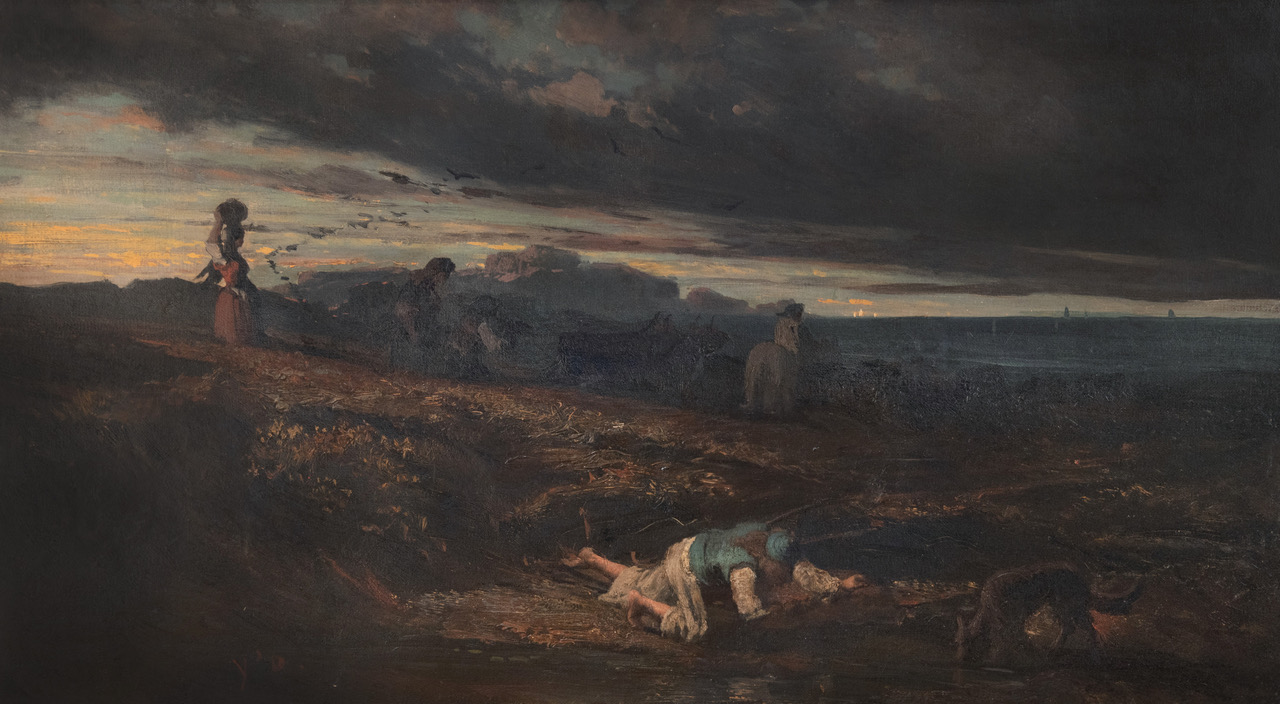
Les Goémoniers
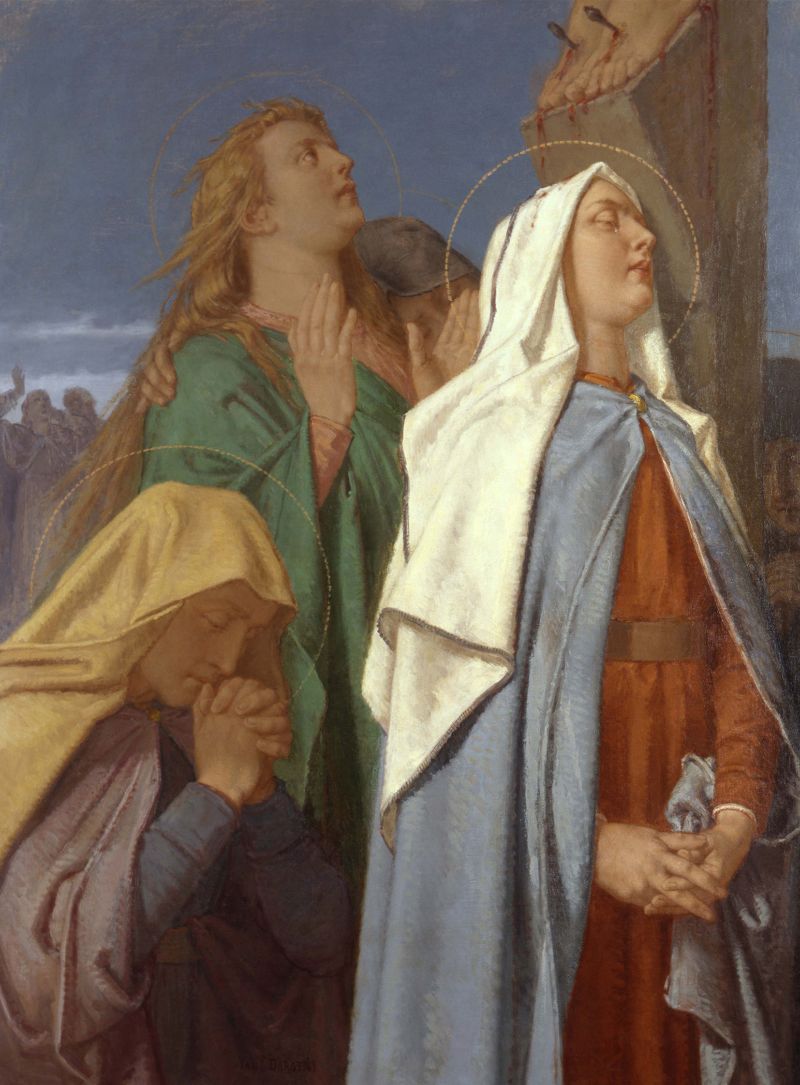
Saint John and the holy women at the foot of the cross.
THE PARISH ENCLOSURE
Saint-Servais benefited from the wealth generated by flax growing in the 17th century, as evidenced by its superb parish enclosure. In the 1870s, Yan’ Dargent decorated the church and ossuary of Saint-Servais. He designed stained-glass windows, murals and several paintings. Along with Quimper Cathedral and Saint-Houardon Church in Landerneau, the beautiful Saint-Servais enclosure is one of the most enriched by Yan’ Dargent’s work.
Proof of his attachment to his native commune, Yan’ Dargent created several paintings for his church: Christ in Majesty surrounded by his apostles, The Virgin at the Rosary, The Baptism of the Jordan, and the cartoons for the stained-glass windows. Since then,AMY’D has acquired and displayed in the church four paintings from a monastery – Ecce Homo (Christ presented to the crowd), Crucifixion (the Virgin, Saint John and Mary Magdalene at the foot of the Cross), Saint Benedict and Saint Scholastica, Assumption of the Virgin -, a large painting originally created for the ossuary, The Death of Salaün le Fol, another smaller version of this Folgoët legend.
For the ossuary, Yan’ Dargent created the following murals: Ar bedenn hag an aluzenn a denn an eneoù a boan (prayer and almsgiving deliver souls), an Ecce Homo, le Mort et le Vif, the latter unfortunately deteriorated due to damp during Yan’ Dargent’s lifetime. He painted La Sainte Famille. Finally, he designed the stained-glass window.
All these works have been restored as part of a major project to upgrade the parish enclosure, led by the municipality with the support of various bodies (DRAC, Conseil Départemental, Région Bretagne).
When he died at his son’s home in Paris on November 19, 1899, Yan’ Dargent was, at his request, buried in his home parish. Then, in accordance with his last wishes, his head joined a reliquary shrine in the ossuary in 1907.